
Read time ca. 9 minutes
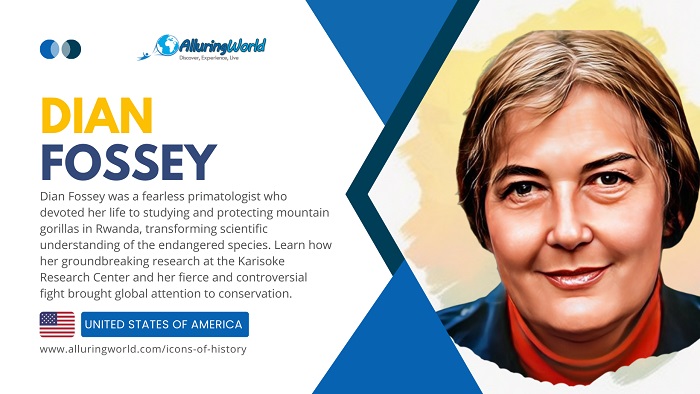
Dian Fossey is a name that has become synonymous with the fierce protection of mountain gorillas, which are considered to be one of the world’s most endangered species, and sooner or later will become on the brink of extinction. Her life was marked by a passion for animals, a determination to preserve wildlife, and an unshakable commitment to conservation in the face of danger and adversity. She is famously known worldwide as one of the greatest primatologists in history, as Fossey devoted her life to studying and protecting gorillas in Rwanda until her untimely death in 1985. Her work not only transformed scientific understanding of gorillas but also brought global attention to the threats of poaching and habitat loss. Her story is one of perseverance, courage, and love for creatures often misunderstood.
Early Life and Education:
Born on 16 January 1932 in the city of San Francisco, California, Fossey’s childhood was shaped by her parents’ separation when she was very young. As her mother and stepfather primarily raised her, Fossey grew up with a feeling of isolation as she often turned to animals for comfort and companionship. From an early age, she demonstrated a natural affinity with animals, caring deeply for them and forming strong emotional connections.
Although she initially pursued a degree in business at the University of California, Davis, Fossey quickly realized it was not her calling. She later transferred to San Jose State College (now San Jose State University), where she earned a degree in occupational therapy in 1954. This career path allowed her to work in hospitals and with patients, but her heart longed for something more adventurous.
Her passion for animals led her to dream of working with wildlife in Africa, inspired in part by books she read as a child. In 1963, she used her savings to fulfill this dream, traveling to Africa for the first time. This trip would be the turning point of her life.
First Encounters with Africa:
Her first journey to Africa was to Kenya, Tanzania, Congo, and Zimbabwe, and it was in Africa where she met famed anthropologists Mary and Louis Leakey, who were conducting groundbreaking research on human origins. Fossey was captivated by the idea of studying primates in their natural habitat, and the Leakeys encouraged her interest.
Her encounter with mountain gorillas in the Congo left an everlasting impression, and as she observed them in the wild for the first time, this experience gave her an immediate sense of connection and purpose. She vowed to return to Africa one day, determined to dedicate her life to studying these magnificent creatures.
Establishing Research in Rwanda:
That determination was created as an opportunity in 1966 when Louis Leakey, who was very impressed by her passion and determination, offered her the chance to conduct long-term field research on mountain gorillas in Rwanda. Following in the footsteps of Jane Goodall, who studied chimpanzees, and Biruté Galdikas, who worked with orangutans, Fossey became part of the famous trio of women known as “Leakey’s Angels.”
In September 1967, she established the Karisoke Research Center in the Virunga Mountains of Rwanda. This area, situated between Mount Karisimbi and Mount Visoke, was remote and challenging to access. Living in basic conditions, often in isolation, Fossey faced harsh weather, illness, and the constant threat of poachers. Yet her determination never wavered.
Through patience and persistence, she gradually gained the trust of the gorillas. By imitating their behaviors, such as crouching, making vocalizations, and avoiding direct eye contact, she was able to approach them without causing alarm. Throughout time, she managed to develop quite close bonds with several gorillas, and through documenting their social structures, relationships, and daily habits, Fossey managed to capture unprecedented details that no other researchers were able to in the past.
ADVERTISEMENT
Groundbreaking Discoveries:
Fossey’s research revolutionized scientific understanding of mountain gorillas. Before her work, gorillas were often portrayed as aggressive and dangerous. Her observations proved the opposite. She showed that gorillas were gentle, social creatures who lived in close-knit family groups led by a dominant male, known as a silverback.
Her meticulous records provided insight into gorilla communication, nurturing behaviors, and the deep bonds within their families. Fossey’s work revealed their intelligence, emotions, and sensitivity, challenging stereotypes and encouraging empathy among the public.
She also emphasized the importance of individual gorillas, often giving them names such as Digit, one of her most beloved companions. One of the “best friends” of Dian Fossey would prove to be Digit, who was a young male who became very symbolic to her work; however, his tragic untimely death at the hands of poachers in 1977 deeply affected her and fueled her conservation efforts.
Fierce Conservation Efforts:
Fossey’s research was only part of her mission. The other, equally important, was protecting the gorillas from extinction. The 1970s brought an alarming rise in poaching and habitat destruction. Gorillas were killed for trophies, bushmeat, or captured for zoos, while snares set for other animals often maimed or killed gorillas as well.
Fossey fought tirelessly against these threats. She organized anti-poaching patrols, destroyed snares, and often confronted poachers directly. Her methods were controversial, sometimes involving aggressive tactics, but she believed extreme measures were necessary to save the gorillas. She referred to her conservation approach as “active conservation,” insisting that research alone could not protect the species.
Her relationship with local communities was complex. Despite some locals appreciating her groundbreaking work to protect Rwanda’s natural heritage and all the efforts she was making in learning as much as possible about these majestic creatures, it was unfortunate that others saw her as an outsider interfering in their livelihoods. Still, Fossey remained unwavering in her mission, often funding patrols with her own money and raising international awareness about the plight of the gorillas.
“Gorillas in the Mist”
In 1983, Dian Fossey published Gorillas in the Mist, a book that combined her scientific observations with personal stories of her years living among gorillas. The book brought her work to a global audience, making the gorillas’ struggles known far beyond Africa. It portrayed not only the beauty and intelligence of the gorillas but also the dangers they faced.
The book became a bestseller and later inspired the 1988 film of the same name, starring Sigourney Weaver as Dian Fossey. The entire film is created around her status as an iconic figure who has dedicated her life to conservation, while ensuring that her story continues to inspire future generations.
Tragic Death:
Unfortunately, Dian Fossey met a tragic end on 26 December 1985, when she was found brutally murdered in her cabin at the Karisoke Research Center. The reports stated that she had been struck with a machete, which is a standard tool often used by local poachers whom she had spent years combating. Her death and the circumstances of how she was murdered have long fueled speculation, and many believed that it was a direct result of her aggressive and unwavering campaign to protect mountain gorillas from the illegal wildlife trade. Her confrontational methods, which included destroying snares and confronting poachers, had made her many enemies.
The identity of Fossey’s killer remains unconfirmed, adding a layer of mystery to her demise. While a Rwandan court convicted one of her research assistants, Wayne McGuire, in absentia, he has always maintained his innocence, and many others, including Fossey’s friends and colleagues, believe the murder was orchestrated by those involved in the poaching of gorillas. It is, in fact, the lack of a definitive resolution to prove who precisely murdered her that has made her death a persistent topic of debate among conservationists and those who followed her life’s work.
Fossey’s murder, while tragic, brought worldwide attention to the dangerous realities faced by conservationists working to protect endangered species in conflict zones. Her murder underscored the high stakes of her entire work, including the powerful forces of the illegal wildlife trade. Despite her life being short, it was in fact her death that served as a powerful testament to her dedication and sacrifice, and further cemented her legacy as a martyr for gorilla conservation and inspiring future generations of environmental activists.
Legacy and Influence:
Dian Fossey’s impact did not end with her death. Her pioneering research continues through the Dian Fossey Gorilla Fund International, which supports gorilla conservation, scientific research, and education. The Karisoke Research Center remains active, staffed by Rwandan and international researchers who carry forward its mission.
Thanks to her efforts, mountain gorilla populations, once on the brink of extinction, have slowly increased. It is reported by conservationists in recent years that the number of gorillas in Rwanda, Uganda, and the Democratic Republic of Congo is seen to be rising which is a testament to the foundations she laid.
Beyond science, Fossey changed the way the world viewed gorillas. She managed to show them as humanoids as they showed their capacity for love, care, and community. In addition, her story also highlighted the importance of protecting endangered species and the ecosystems they inhabit, inspiring countless people to pursue careers in conservation and environmental advocacy.
Conclusion:
In conclusion, Dian Fossey’s life was not an easy one. It was filled with hardship, danger, and sacrifice, but it was also rich with purpose and extraordinary accomplishments. From humble beginnings in California to the misty mountains of Rwanda, it is an inspirational story to see that she followed her passion with relentless determination. Her groundbreaking research redefined humanity’s understanding of gorillas, and her fearless fight against poaching brought global attention to conservation.
Though her life ended violently, her legacy endures. She showed the world that one individual’s dedication could make a difference, even against seemingly insurmountable odds. Today, the growing population of mountain gorillas stands as living proof of her vision and courage. Dian Fossey will forever be remembered as the woman who gave her life to protect the gentle giants of the mist.