
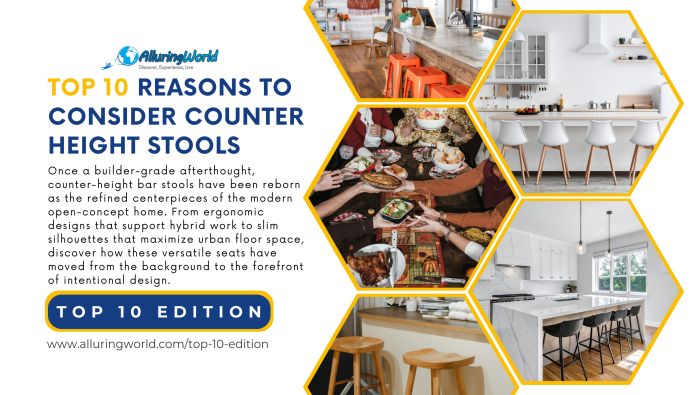
For years, counter height bar stools were seen as furniture to sit in the designers’ background, quietly being almost ignored. While they were very practical, they were also too convenient for certain places, but they were not seen as stylish. At least not always. At one point in time, they became the symbol of rushed kitchen remodels and builder-grade dining spaces. You can instantly spot them in the room, and they were most of the time lined up under granite counters in early 2000s homes.
Nevertheless, as designs change, and old things can trend again, today, counter height bar stools are no longer the awkward middle child between dining chairs and tall bar stools. Today, instead, they are refined, intentional, and in many cases, the centerpiece of a space. If you consider having counter height bar stools, then here are 10 reasons to decide on them.
1. The Height That Fits Real Life
One of the reasons for the revival is that counter height works. Standard kitchen counters measure about 91 cm (36 in) high, and this makes counter-height stools, typically with a 61 cm (24 in) to 66 cm (26 in) seat height. This is considered the most ergonomic choice for everyday use, but unlike bar-height seating, which often feels formal or slightly elevated, disconnecting people from the room, counter-height seating feels more grounded. The numbers tell the story:
- Most new American homes now feature open-concept kitchens, accounting for over 70 percent of new builds.
- Kitchen islands have become a central feature in renovation projects, with seating included in more than 60 percent of remodels.
- Counter-height seating encourages longer stays than traditional bar-height setups, according to interior lifestyle surveys.
When people cook, work from home, help with homework, or gather casually, the counter becomes the natural hub in their home, and the stool must support these, thus making counter height very effortless.
2. From Bulky to Beautiful
If you are used to seeing the older counter-height bar stools with heavy proportions, especially with their thick backs, oversized cushions, and ornate details, then you must think this is quite dated. On the other hand, the modern comeback is rooted in restraint, so today’s designs focus on cleaner lines, lighter materials, and thoughtful silhouettes. What you saw in the past as bulky padding and excessive ornamentation, this is today replaced by slim metal frames, curved wood backs, woven seats, and neutral upholstery. This transformation can be broken down into three design shifts:
- Materials have become more refined. Solid wood, powder-coated steel, and performance fabrics now dominate the category.
- Profiles are slimmer. Open backs and minimal footrests reduce visual weight.
- Colors are softer. Warm woods, matte black, cream, and natural tones feel current without screaming for attention.
With this, you can see that what once felt like a placeholder piece now feels curated and more modern for your eyes.
3. The Instagram Effect
In today’s modern age with the advancement of technology, social media has played a quiet but powerful role in the comeback. Kitchens are among the most photographed rooms in a home, so a well-styled island with counter-height bar stools becomes an instant visual anchor in lifestyle photography on Instagram or anywhere else, for that matter.
In cafés and boutique restaurants, designers have also embraced counter-height seating to create more layered spaces. Instead of relying only on traditional restaurant chairs and tall bar stools, many hospitality spaces now mix heights to add depth and intimacy. A 61 cm (24 in) stool paired with a stone island, pendant lighting, and textured walls creates balance and an inviting space without towering above others in the room.
4. Comfort Wins Every Time
People’s comfort today is beyond aesthetics, and it has become non-negotiable. As more people work remotely, kitchen counters could double as their work desks. When you sit for extended periods of time, you must have back support, proper seat depth, and stable footrests. This has been addressed with the newer generation of counter-height barstools. You should definitely consider these practical factors:
- A seat depth of at least 36 cm (14 in) improves comfort for extended sitting.
- Footrests positioned 15 to 30 cm (6 to 8 in) below the seat will help you to reduce leg strain.
- Upholstered or contoured seats increase dwell time in both homes and restaurants.
When you have these details nailed down, then the comfort will translate directly into behavior. In hospitality settings, longer seating times often correlate with higher ticket averages. In homes, it means people linger, their conversations stretch, and even meals will blur into late-night chats.
5. Blurring the Line Between Residential and Commercial
Another reason for the resurgence of the counter-height stools and why you should consider them is the growing overlap between residential and commercial design. On one hand, homeowners want kitchens that feel like boutique cafés, while on the other, restaurants want seating that feels relaxed and residential. This is where counter-height barstools fit perfectly in that space.
In commercial spaces, they allow designers to create semi-elevated zones without committing to full bar height. At the same time, in homes, they offer the casual comfort of dining chairs while maintaining the functionality of island seating. In addition to this, the crossover appeal has also expanded the design vocabulary, so you now see leather-wrapped backs, woven rattan inserts, industrial metal frames, and Scandinavian-inspired wood forms, all within the counter-height category.
ADVERTISEMENT
6. The Psychology of Not Being Too Tall
If you believe that you are not tall enough, then the counter-height stools play a somewhat subtle psychological component in their comeback. Bar height seating can feel performative, as it will elevate you physically, which can create a slight sense of formality or separation. Counter-height seating, by contrast, keeps everyone at eye level in open spaces, and that difference changes the energy of a room.
At 91 cm (36 in), the counter becomes a shared surface rather than a stage so that people can lean in, pass plates, and make further eye contact without feeling perched.
7. A Comeback That Feels Intentional
You have noticed in the past that trends often return ironically before becoming sincere again. Counter height bar stools have completed that journey, and what was once considered slightly dated has been reinterpreted differently today.
Nowadays, that category feels more intentional; it fits contemporary floor plans, supports hybrid work lifestyles, and most importantly, ithotographs well.
8. The Rise of Versatile Multi-Tasking
Your home today is no longer with dedicated rooms intended for single activities. The kitchen island is now a boardroom, a classroom, and a dinner table all in one. Counter-height stools are the primary tools facilitating this shift, so unlike lower dining chairs that can feel too relaxed for a Zoom call, or bar stools that feel too “pub-like” for a serious task, counter-height seating provides a more professional “perch” for you
With them, you will get an upright posture that supports focus while remaining integrated into the heart of the home. This versatility has cemented the stool’s status not as a luxury, but as a functional necessity for the hybrid-work era, and it will continue to evolve even further.
9. Small Space Optimization
As urban living spaces and “tiny home” concepts continue to influence design, the efficiency of counter-height seating has become a major selling point. In smaller floor plans, a dining table is often a spatial luxury that many can’t afford, so when you have a kitchen counter that is paired with sleek, low-profile stools, it simply eliminates the need for a separate dining room entirely. Because these stools are designed to tuck completely under the counter when not in use, they maintain clear sightlines while maximizing your floor space. This “invisible” footprint allows even the most compact apartment to feel open and airy, proving that good design is as much about what you don’t see as what you do.
10. Where This Revival Is Headed Next
When you look ahead, the evolution is likely to continue in a few key directions:
- Increased use of sustainable materials, such as FSC-certified wood and recycled metal.
- Greater customization in upholstery and finishes.
- Integration of subtle design details, such as curved backs and textured fabrics, to enhance tactile appeal.
With the constant convergence in style and function, counter-height bar stools are positioned at the moment to remain relevant. They will offer you the flexibility without sacrificing your comfort, they will support your conversations without dominating the room, and much more. What once felt like a design misstep has become a quiet statement of balance.
In conclusion, the journey of the counter-height bar stool, as seen from a builder-grade afterthought to a design-forward staple, reflects a larger shift in how we value our time spent in our homes. While we have moved away from the rigid formality of the past toward a style of living that is fluid, social, and inherently comfortable, we are prioritizing ergonomics while embracing minimalist aesthetics. At the same time, we acknowledge the psychological power of eye-level interaction, so we should see more designers to turn a simple seat into a catalyst for connection. The counter-height comeback isn’t just a trend; it is a recognition that the best designs are the ones that accommodate the messy, beautiful, and multi-functional reality of modern life. They don’t just fill a space; they create a place.