
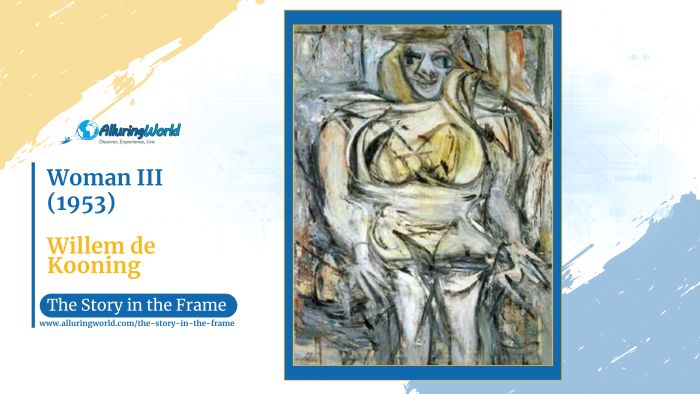
Painted in 1953, Woman III by Dutch-American artist Willem de Kooning is a seminal work in Abstract Expressionism, exemplifying his exploration of the female form through gestural abstraction and dynamic energy. This painting is part of his celebrated Woman series, and this painting demonstrates de Kooning’s ability to merge figuration with expressive, painterly technique, thus creating a complex interplay between form, emotion, and movement.
About the Painter:
Willem de Kooning (1904–1997) was a Dutch-American painter, born in Rotterdam, the Netherlands, and he is famous as a leading figure in Abstract Expressionism. De Kooning was trained in the Netherlands and later active in New York, and throughout his years, he developed a style characterized by vigorous brushwork, layered textures, and a dynamic approach to composition. His work frequently explores the human figure, urban life, and abstract forms, consequently blending gestural intensity with formal experimentation. Overall, de Kooning is celebrated for his innovative synthesis of abstraction and figuration, and he managed to influence numerous generations of artists worldwide.
Inspiration and Reasons Behind the Painting:
De Kooning painted Woman III during a period of intense engagement with the female form, exploring its formal qualities and symbolic significance. The Woman series reflects his interest in the tension between attraction and aggression, beauty and grotesque distortion, as he wanted to express himself through painting the appreciation he had for the female figure. Woman III most likely draws inspiration from classical depictions of women, modernist abstraction, and de Kooning’s own psychological and aesthetic exploration of human presence, emotion, and energy.
What is Depicted in the Painting:
The overall composition of the painting is centered on a frontal depiction of a woman, although the form is abstracted and distorted through vigorous brushwork. As there are no clear facial features and body parts visible in the painting, they are suggested rather than defined, with sharp angles, sweeping lines, and fragmented forms creating a sense of movement, intensity, and psychological complexity. The figure dominates the canvas, conveying both physical presence and emotional force. De Kooning’s approach emphasizes the tension between recognizable human form and abstract expression, inviting viewers to engage with both visual and emotional perception.
Colors and Techniques:
De Kooning employs a vibrant, contrasting palette dominated by pinks, whites, blacks, and flesh tones, layered and scraped to create texture, depth, and energy. At first glance, his brushwork is clearly aggressive, gestural, and dynamic, but it often leaves marks visible to emphasize the act of painting itself. Light and shadow are suggested through color contrast rather than realistic rendering, consequently enhancing the dramatic and expressive qualities of the figure. The combination of color, form, and texture creates a sense of vitality, motion, and psychological tension.
Conclusion:
To sum it all up, Woman III exemplifies Willem de Kooning’s mastery of Abstract Expressionism, merging figuration, gesture, and emotional intensity into a single, compelling composition. Through dynamic brushwork, bold color, and abstracted form, the painting captures both physical presence and psychological depth, transforming the depiction of the female figure into a powerful exploration of energy, emotion, and artistic innovation. Perhaps this is one of de Kooning’s most iconic works and a landmark of mid-20th-century modern art that shall continue to influence future artists.