
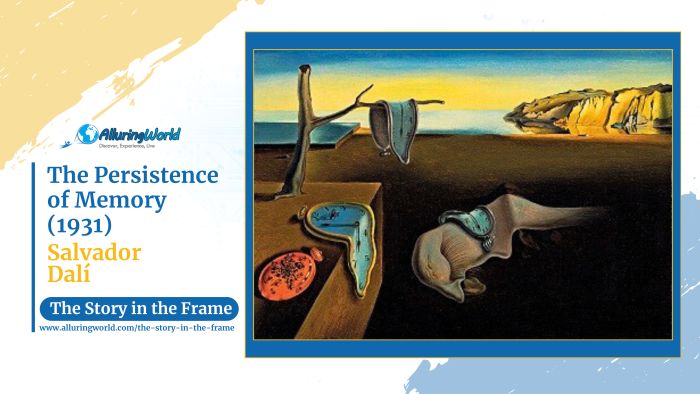
The Persistence of Memory by Spanish Surrealist master Salvador Dalí is one of the most iconic and instantly recognizable works of 20th-century art. Painted in 1931, this interestingly unique painting explores the fluidity of time, dreamlike imagery, and the subconscious, embodying the principles of Surrealism and Dalí’s unique visionary imagination.
About the Painter:
Salvador Dalí (1904–1989) was a Spanish painter, sculptor, and writer renowned for his eccentric personality and imaginative Surrealist works. He was trained at the Royal Academy of Fine Arts in Madrid, from where Dalí developed a highly precise, almost photographic painting technique, which he combined with bizarre, dreamlike imagery. His work is unlike that of other artists, and it often explores the unconscious, dreams, sexuality, and the passage of time, making him a defining figure of the Surrealist movement.
Inspiration and Reasons Behind the Painting:
Dalí painted The Persistence of Memory during a period when Surrealism was at its height. He managed to draw inspiration from Freudian theories of dreams and the unconscious, and his quite vivid imagination. The melting clocks that can be seen in the painting symbolize the relativity and fluidity of time, while the barren landscape and strange organic forms reflect a dreamlike, distorted reality. What Dalí sought to achieve with this painting is to challenge rational perception and explore the malleability of memory, time, and human consciousness.
What is Depicted in the Painting:
The composition features a desolate, almost barren landscape with a coastline visible in the distance. Soft, melting clocks drape over tree branches, a ledge, and a distorted, amorphous figure at the center. There can be seen ants in the lower left corner of the painting that crawl over a pocket watch, symbolizing decay, while shadows and strange, fluid forms heighten the sense of unreality. The juxtaposition of familiar objects in surreal, impossible positions creates a dreamlike, uncanny atmosphere, provoking contemplation on the passage of time and the nature of memory.
Colors and Techniques:
Dalí employs a restrained but vivid palette, combining earthy browns, ochres, deep blues, and golden tones to create a stark yet luminous environment. His meticulous, smooth brushwork renders the surreal forms with photographic precision, enhancing their believability within an impossible context. The use of shadow and perspective adds depth, making the dreamlike scene feel simultaneously realistic and fantastical.
Conclusion:
In conclusion, the Persistence of Memory exemplifies Salvador Dalí’s visionary imagination and mastery of Surrealist principles. Through dreamlike imagery, melting clocks, and precise technique, the painting challenges conventional perception of time, reality, and memory. It remains one of Dalí’s most celebrated works and a defining symbol of Surrealism, continuing to captivate and inspire audiences worldwide.