
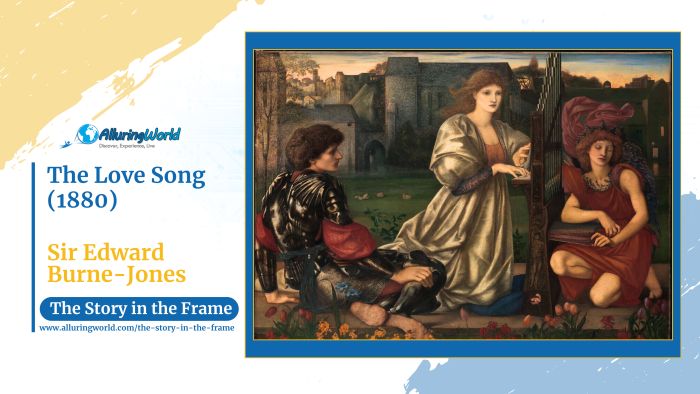
The Love Song by Sir Edward Burne-Jones is a quintessential Pre-Raphaelite that was painted in 1880, and this is a work that evokes romance, music, and poetic atmosphere in the admirer of the masterpiece. The painting reflects Burne-Jones’ fascination with myth, allegory, and medieval-inspired imagery, while at the same time presents a lyrical moment that merges human emotion with decorative elegance.
About the Painter:
Sir Edward Burne-Jones (1833–1898) was a British artist associated with the Pre-Raphaelite Brotherhood and the later Aesthetic movement. Renowned for his allegorical, mythological, and literary subjects, Burne-Jones combined intricate detail, idealized forms, and a refined, decorative style. His work influenced both painting and design, including stained glass and illustration, emphasizing beauty, emotion, and craftsmanship.
Inspiration and Reasons Behind the Painting:
As The Love Song was inspired by medieval and Renaissance ideals of romance, courtship, and poetic storytelling, the painting speaks about different mythological times. Burne-Jones sought to capture the transcendent beauty of love, which was expressed through music and gesture, as he has shown this perfectly in the painting, thus creating a scene that is symbolic and emotionally resonant. While the painting reflects the Pre-Raphaelite interest in idealized beauty, the overall narrative speaks about the intimacy, as well as the harmony between figure and setting.
What is Depicted in the Painting:
There are three figures; however, the composition is centered on a young woman who is seated in a lush, decorative landscape, playing a stringed instrument while her companion listens to her playing notes quite attentively. All the figures are elegant and elongated, dressed in flowing robes reminiscent of medieval or classical attire, as some might suggest that this happened in ancient times when myths were being created. They are surrounded by a richly adorned environment of flora, patterned textiles, and architectural elements that enhance the romantic and timeless quality of the scene. The overall interaction that is seen in The Love Song painting conveys intimacy, poetic sentiment, and the shared pleasure of music and courtship.
Colors and Techniques:
Overall, Burne-Jones employs a harmonious palette of muted jewel tones, including deep blues, soft golds, warm reds, and gentle greens. His exquisite brushwork is very smooth and meticulous, thus emphasizing the flowing contours of fabric, the delicate rendering of faces, and the ornamental details of the setting. While it can be seen that the light is soft and somewhat diffused, it creates something like a dreamlike, contemplative atmosphere that reinforces the painting’s poetic mood.
Conclusion:
In conclusion, the Love Song exemplifies Sir Edward Burne-Jones’ ability to merge narrative, allegory, and aesthetic refinement. His showing of elegant figures, harmonious composition, and decorative detail evokes the beauty and emotion, especially when this is shown through the music and storytelling. Consequently, the Love Song by Sir Edward Burne-Jones remains a notable example of Pre-Raphaelite artistry and his enduring influence on 19th-century British painting.