
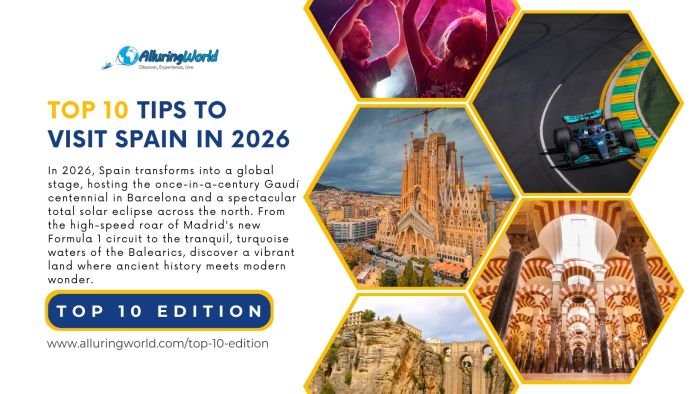
Spain has always been on the must-visit list of countries for many people, and it will continue to inspire people to visit it with its rich blend of architectural wonders, sun-soaked beaches, and numerous vibrant cultural traditions. As a matter of fact, 2026 is the year that is considered ot be a special one, because the Iberian Peninsula prepares to host a series of once-in-a-lifetime events that elevate it from a mere destination to a global stage of wonder.
If you’re considering exploring this fascinating country, with different Spain vacation packages 2026, you will get carefully curated itineraries that will show you the very best of what Spain has to offer, blending historic reverence with the pulse of modern Spanish life. If you are interested in seeing historic cities, mountain villages, or coastal retreats, then Spain is a world of discovery at every turn you take.
With the amazing diversity of Spain, this means that you can explore Roman ruins in the morning, sample tapas in a bustling market at midday, and watch flamenco dancers late into the evening. Most important of all, each of the Spanish regions has its own character, culinary traditions, and stories to tell, so you certainly have to prioritize what you want to experience and/or see during your travels. In 2026, the rhythm of Spain is faster, the colors are more vivid, and the invitations to explore are more compelling than ever before. Below are just some more important events that should capture your attention and bring you an excellent Spanish experience.
1. Barcelona and the Gaudí Centennial
Barcelona stands as a testament to artistic vision and architectural innovation, but 2026 marks perhaps its most significant year in a century. As the world commemorates the 100th anniversary of Antoni Gaudí’s passing, the city becomes a living museum. The Sagrada Família continues to evolve, with 2026 targeting major completion milestones for its central towers. If you get the chance to walk through the basilica, you will feel like stepping into a forest of stone columns, each one supporting a ceiling that seems to float overhead, while the exterior facades tell stories etched in stone. Beyond this, Park Güell and Barcelona’s Gothic Quarter offer layers of history where Roman walls still stand alongside modernist whimsy.
2. The “Path of Totality” in Northern Spain
Maybe one of the most popular events that will happen this year in Spain is the total solar eclipse, which will occur on 12 August 2026. This astronomic event will sweep across Northern Spain, making cities like Gijón, Bilbao, and Zaragoza the most sought-after coordinates on the planet, and places where many people will head. This celestial event, which is the first total eclipse in the region in over a century, transforms the rugged Cantabrian coast and the Ebro Valley into prime viewing theaters. If you imagine the sun’s corona shimmering over the Guggenheim Museum in Bilbao or the rocky coves of the Costa Brava, be aware that this is a moment where nature and culture align in perfect, darkened harmony, and it is an event you should not miss.
3. Madrid’s Regal Formality and New Speed
Since Madrid is the capital city and is located in the central part of the country, it presents a different narrative. Never to be missed is the Royal Palace, which stands as one of Europe’s largest palaces, with over 3,000 rooms decorated in rococo and neoclassical styles. But, despite this amazing jewel, 2026 will have something extra in Madrid with the arrival of the Formula 1 Grand Prix on a specialized hybrid circuit. If you are a Formula 1 fan, this is an opportunity that will be quite unique and cannot be missed. When you aren’t hearing the roar of engines, find solace in the Prado Museum, which houses masterpieces by Velázquez and Goya. The city’s grand boulevards, such as the Gran Vía, showcase early 20th-century architecture, while neighborhoods like Malasaña blend historic buildings with contemporary street art.
4. The Timeless Allure of the Alhambra in Granada
Granada’s Alhambra palace complex represents the pinnacle of Moorish architecture in Spain. In 2026, the demand for this site remains unparalleled, requiring travelers to book months in advance to see the intricate tile work and peaceful courtyards of the Nasrid Palaces. The contrast between the Alhambra’s delicate beauty and the imposing Renaissance palace built beside it tells the story of Spain’s complex history. Below the fortress, you will find the Albaicín neighborhood, which continues to maintain a distinctly North African character with its winding streets and jasmine-scented tea houses.
5. The Turquoise Waters of the Balearic Islands
Known worldwide mostly for their amazing parties, the islands of Mallorca, Menorca, Ibiza, and Formentera offer a distinct personality for the 2026 traveler. Despite being known mostly for its nightlife, Ibiza can also reveal to you a surprisingly peaceful side that can be filled with pine-covered hills. On the other hand, Formentera’s shallow turquoise waters and white sand beaches create a Caribbean-like atmosphere in the heart of the Mediterranean, which can transport you to a different world. Overall, these islands are perfect for those who wish to pair their cultural exploration with the restorative power of the sea and amazing nightlife.
ADVERTISEMENT
6. Seville and the Heart of Andalusia
Seville embodies Andalusian culture with its flamenco performances and vibrant festivals. From its historic structures, the massive Gothic cathedral, which was built on the site of a former mosque, still incorporates the original minaret, but nowadays it is known as La Giralda tower. The city has made a commitment in 2026 to sustainable tourism, and this has made it easier for the visitors to navigate its hidden plazas by bike or on foot. The Real Alcázar palace complex remains a highlight for every Seville visit, as it blends Islamic, Gothic, and Baroque elements into a garden-filled sanctuary that has famously served as a backdrop for cinematic epics.
7. Culinary Innovation in the Basque Country
The Basque Country has changed its image to the world, and from a former rural, agricultural, and iron-mining society, nowadays it is famous for its modern architecture, great connections, and even better food scene. This Spanish region earned its international recognition for its innovative cuisine, and every year, you can see a new generation of chefs who are pushing the boundaries of “New Basque” flavors. The resort town of San Sebastián boasts more Michelin stars per capita than almost any other city in the country or the world, and yet its pintxos bars serve world-class food in casual settings. These small bites create an amazing gastro experience that you probably cannot experience in other places. Nevertheless, the Basque Country is, in fact, a region where the rugged Atlantic coastline meets a sophisticated, modern palate and creates a memorable experience for everyone.
8. Valencia: The City of Oranges and Future Science
Due to its location, just south of Barcelona, Valencia is sometimes a city that is explored on a day trip from Barcelona. Still, if you decide to stay in Valencia for some time, then the city will provide you with an excellent base for exploring urban attractions and nearby beaches. The most famous and futuristic place is the City of Arts and Sciences, which looks like it belongs in the next century. Located in the central part of Valencia, what was once a riverbed, this is something you cannot miss, and you can further compare it with the old town, where it retains its medieval charm. As the birthplace of paella, Valencia is a pilgrimage site for food enthusiasts. In 2026, the city’s green belts and parklands offer a cool, shaded escape from the Mediterranean sun.
9. The White Villages of Ronda and Beyond
Southern Spain’s pueblos blancos (white villages) dot the mountainous interior. Their gleaming whitewashed buildings stand out against rugged terrain and create a mesmerizing view that you cannot easily forget. Ronda perches dramatically on the edge of a deep gorge, which is connected by an 18th-century bridge. While these villages will offer you a slower pace when compared to the big cities, you will have the opportunity to hear the ringing of church bells and the scent of orange blossoms, which dominate the senses. Perhaps what these villages are known for is the “slow travel” movement that is becoming the hallmark of the 2026 travel season.
10. Córdoba’s Mezquita and Flower-Filled Patios
One of the most unusual buildings in the world is Córdoba’s Mezquita, or as the English name would be Mosque–Cathedral of Córdoba. This historic structure stands as one of the world’s most unusual religious buildings since it was built as a mosque with a forest of striped arches and columns, but then was converted into a cathedral, resulting in a striking architectural hybrid of Christian and Muslim architectural styles. To top it all, the city’s Jewish quarter, with its narrow lanes, provides insight into medieval life, so if your 2026 journey brings you here in spring, then you’ll experience the annual Patio Festival as it allows you to step inside private, flower-adorned courtyards that are usually hidden from public view.
In conclusion, planning your Spanish adventure in 2026 is made seamless by the country’s world-class infrastructure. AVE trains connect major cities with high-speed efficiency, whisking you from Madrid to Barcelona in under three hours. With this, you can cover more ground and see the major tourist attractions.
Timing your visit is essential; while summer brings the excitement of the eclipse and the peak of beach season, spring and fall offer a more temperate climate for exploring the interior. Understanding Spanish daily rhythms, starting from the late-night dinners, the afternoon siesta, and even the communal joy of the “paseo” (evening stroll), is the key to unlocking the true spirit of the country. Overall, if you are following the shadow of the moon across the north or the trail of Gaudí in the east, Spain in 2026 is a destination that rewards the curious and the bold. It is a place where history does not sit on a shelf; it lives in the streets, the kitchens, and the hearts of its people, so grab the chance and visit this always impressive European gem.