
Read time ca. 7 minutes
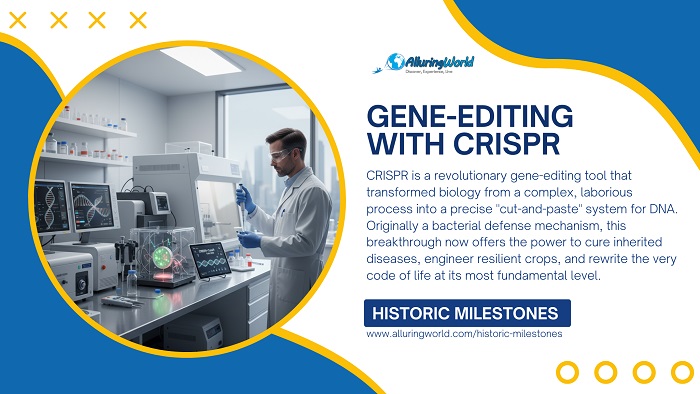
There have been a few profound breakthroughs in biology that have reshaped humanity’s understanding of this natural science, but among the most important ones is considered to be CRISPR. This revolutionary gene-editing tool transformed genetic research from a complex, laborious process and turned it into something precise, efficient, and widely accessible. Once it was made possible, CRISPR simply redefined what scientists believed to be possible by that time, as this opened new pathways in medicine, agriculture, and biotechnology. Being more than just a discovery, this scientific breakthrough represents a shift in humanity’s ability to influence life at its most fundamental level.
The Birth of a Genetic Revolution:
The story of CRISPR began not in the laboratories of geneticists but in the natural defense mechanisms of bacteria. Decades before its potential was understood, researchers noticed unusual repeating sequences in bacterial DNA; this was, in other words, called clustered regularly interspaced short palindromic repeats, or in short, CRISPR. These mysterious patterns, first described in the late 1980s, puzzled scientists for years until it became clear that they formed part of an ancient microbial immune system.
Bacteria used CRISPR sequences to recognize and neutralize invading viruses. When a virus attacked, bacteria could capture snippets of its DNA and store them in their genome. If the same virus invaded again, the bacteria would produce RNA molecules that matched the viral sequence and direct specialized enzymes, such as Cas9, to cut the intruder’s DNA apart. This elegant, self-protective system would soon inspire one of the most significant technological revolutions in biology.
From Curiosity to Breakthrough:
The work that was carried out, from understanding bacterial defense to editing genes in humans, came through the meticulous work of researchers like Jennifer Doudna and Emmanuelle Charpentier. They managed to publish in 2012 a groundbreaking paper that demonstrated how the CRISPR-Cas9 system could be adapted to target and edit specific DNA sequences in any organism. Their discovery simplified genetic modification in a way previously unimaginable, because from this point on, scientists could “cut and paste” genes with great accuracy and relative ease.
What set CRISPR apart was its simplicity and versatility. Traditional gene-editing techniques were expensive, slow, and technically demanding. CRISPR, by contrast, required only a guide RNA and the Cas9 enzyme to locate and cut specific DNA sequences. Once the cut was made, the cell’s natural repair mechanisms could insert or delete genetic material, allowing researchers to alter genes with precision that bordered on science fiction.
Engineering Life: From Laboratories to Real-World Applications:
Due to the amazing work that was done by the scientists, CRISPR’s influence spread rapidly across the scientific world, so within just a few years, laboratories around the globe were already using the technology to study and change the way genetic diseases were appearing, improve the crops and overall productivity, and finally explore the genetic foundations of life itself. Seen from the medical perspective, CRISPR was seen as a potential to correct inherited disorders directly at the DNA level. Early experiments in sickle cell anemia and muscular dystrophy revealed promising results, showing that CRISPR could repair faulty genes responsible for devastating conditions.
Beyond medicine, CRISPR’s potential extended to agriculture and environmental science. Crops were suddenly made to be resistant to pests, drought, and disease, as scientists managed to reduce the reliance on chemical pesticides and improve yields, particularly in challenging climates. Furthermore, livestock could be bred for better health and productivity, while conservationists explored gene-editing tools to protect those species that were considered endangered or even combat invasive ones that would bring havoc to some regions. This was the technology that was no longer confined to theory but was actively reshaping the world we live in.
Ethical Frontiers and Scientific Responsibility:
Since this gave immense power to scientists and also governments, this revolution, however, raised profound ethical questions. The same technology that was capable of curing diseases could, in theory, alter the genetic makeup of future generations. When a Chinese scientist claimed to have edited the genomes of human embryos in 2018, there was a mixed response to this claim, because the world was astounded and alarmed at the same time. What this did was mark a turning point, forcing governments, scientists, and ethicists to confront the boundaries of genetic intervention.
In addition to this, CRISPR also challenged humanity to redefine its relationship with life. Thus, scientists asked themselves: Should we edit the human germline to eliminate genetic disorders? Could this lead to “designer babies,” where traits such as intelligence or appearance are chosen rather than inherited naturally? The balance between innovation and restraint was revealed to be quite delicate, so global organizations and scientific communities have since called for regulations to ensure that the use of the CRISPR technology would align with ethical principles and societal values, emphasizing transparency, safety, and equity.
Beyond Cas9: Expanding the Genetic Toolkit:
While CRISPR-Cas9, which is a powerful gene-editing tool that uses a guide RNA and a Cas9 enzyme to make precise cuts in DNA, remains the most well-known form in this field, scientists have continued refining and expanding its capabilities. There are also new variations, such as CRISPR-Cas12 and CRISPR-Cas13, and these target different molecules, thus enabling edits to RNA or single base pairs within DNA without causing double-strand breaks. These innovations increase precision and reduce risks, making gene editing safer and more adaptable to specific applications.
Moreover, researchers are also developing “prime editing,” a technique that acts like a molecular word processor, and this option allows the precise correction of genetic errors letter by letter. This next magnificent generation of CRISPR tools holds the potential to address a broader range of genetic diseases and even correct mutations without introducing unintended changes. One thing is certain, and that is the innovation in this field is not going to stop or slow down, and it will continue to evolve toward greater control and sophistication.
ADVERTISEMENT
CRISPR in the Fight Against Global Challenges:
As the 21st century progresses, CRISPR stands at the forefront of efforts to solve some of humanity’s most significant challenges. As CRISPR is being explored for cancer treatment in healthcare, there are also testing grounds for antiviral therapies and the development of personalized medicine, which would be tailored to an individual’s genetic profile. When the COVID-19 pandemic was in full swing, CRISPR-based diagnostic tests were developed to detect the virus quickly and accurately, thus demonstrating its versatility beyond traditional gene editing.
On the other hand, CRISPR promises in agriculture to address food insecurity by creating crops that thrive in poor soils or extreme weather conditions. To top it all, it also offers tools to reduce the environmental footprint of farming, supporting more sustainable practices, while in the meantime, researchers are investigating its role in carbon capture, pollution cleanup, and synthetic biology; fields that could transform industries and ecosystems alike.
The Legacy and Future of CRISPR:
Ushering the whole of humanity into an era where genetic manipulation is no longer confined to theories, the invention of CRISPR has become an accessible and practical reality that is desired more. It represents a democratization of biotechnology, empowering researchers, students, and startups to participate in groundbreaking research. Based on this, what took years and millions in funding to achieve, nowadays, we can do it with relatively simple laboratory tools.
Yet, this accessibility also demands caution. As CRISPR technology moves beyond professional labs into open-source and educational settings, ensuring ethical use becomes even more crucial. How the future of CRISPR is going to be will most likely depend as much on responsible governance as on scientific ingenuity. Collaborative international frameworks will be vital to ensuring that this tool benefits humanity as a whole, rather than deepening inequality or sparking misuse.
Conclusion:
In conclusion, the CRISPR revolution symbolizes one of humanity’s most transformative scientific leaps. This moment seems like an understanding of life’s language and how it became the power to rewrite it. Starting from its humble bacterial origins, and then moving to its global impact on medicine, agriculture, and environmental science, CRISPR stands as a proof of human curiosity and creativity. It bridges the gap between discovery and destiny, offering hope for curing genetic diseases, feeding a growing population, and preserving the natural world.
As science advances, CRISPR will continue to challenge humanity to reflect on what it means to hold such power over the essence of life. The choices made in this new genetic era will define not just the future of science but the moral trajectory of civilization itself.