
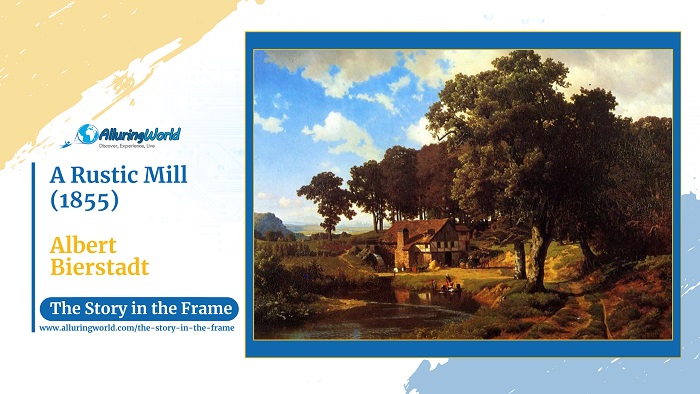
Painted in the mid-19th century, A Rustic Mill by American artist Albert Bierstadt is a picturesque landscape that combines natural beauty with the charm of rural life. The painting is celebrated for its luminous light, meticulous detail, and romanticized depiction of the American countryside.
About the Painter:
Albert Bierstadt (1830–1902) was a German-American painter renowned for his large-scale landscapes of the American West. Trained in Düsseldorf and influenced by the Hudson River School, Bierstadt became famous for his dramatic compositions and detailed observation, capturing both the grandeur and serenity of nature.
Inspiration and Reasons Behind the Painting:
A Rustic Mill reflects Bierstadt’s fascination with idyllic rural scenes and the harmonious coexistence of humans and nature. While much of his fame comes from grand Western vistas, Bierstadt also explored smaller, intimate scenes of daily life, celebrating the tranquility of simpler, rustic environments.
What is Depicted in the Painting:
The composition features a small, weathered mill set along a gently flowing stream, surrounded by lush trees and greenery. Figures tending to daily chores add scale and narrative interest. The scene conveys quiet movement, flowing water, and rustling leaves, imbuing the landscape with vitality. The mill serves as a focal point, blending human presence harmoniously into the natural setting.
Colors and Techniques:
Bierstadt employs a warm and naturalistic palette, with soft greens, browns, and blues dominating the landscape, punctuated by highlights of sunlight. His precise brushwork captures textures of wood, water, and foliage, while subtle contrasts of light and shadow enhance depth and atmosphere. The careful rendering of reflections in the water and dappled sunlight adds a sense of realism and luminous beauty, characteristic of Bierstadt’s approach to landscape painting.
Conclusion:
A Rustic Mill exemplifies Albert Bierstadt’s ability to combine technical precision, romanticized scenery, and narrative subtlety. Through detailed composition, harmonious colors, and attention to light, the painting conveys the quiet beauty of rural life and the natural environment. It remains a testament to Bierstadt’s skill in capturing both the grandeur and intimacy of the American landscape.