
Read time ca. 9 minutes
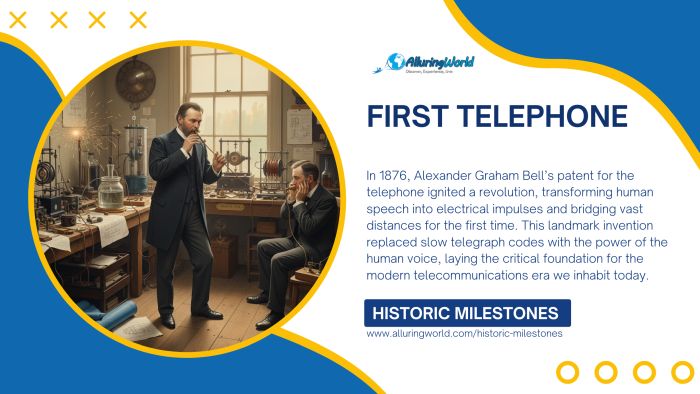
The Scottish-born inventor, Alexander Graham Bell, who resided in the United States, was granted a patent for the telephone in 1876, and this marked a groundbreaking invention that would fundamentally transform human communication. This quite historic milestone linked the long distances between people and laid the foundation for the modern telecommunications era, something which we know today. Throughout time, as the telephone was advancing and improving, it significantly reshaped people’s social interactions, business practices, and made the world a much smaller place. It further allowed people to exchange information in ways that were previously impossible and would require a significant amount of time.
Before Bell made his innovation possible, our long-distance communication was primarily via written correspondence, and since the 1830s, the telegraph systems. These were options that were limited by infrastructure, speed, and accessibility, and even though the telegraph allowed rapid transmission of coded messages over wires, it was limited because it could not convey the human voice, tone, or nuance. This is what made Bell’s telephone more attractive, as it introduced the ability to transmit speech electrically and gave people the chance to hear each other. Nonetheless, its significance is not just seen as a technological advancement, but it also allowed people to use it for further influence on economic development, social structures, and the way individuals relate across vast distances.
Historical Context: Communication Before the Telephone
With the rapid industrialization in the 19th century, urbanization, and technological advancement, the creation of improved communication was in high demand, so the telegraph, which was developed in the early 1800s by Samuel Morse and others, revolutionized information transmission, enabling messages to travel faster than ever before. However, telegraphs required trained operators and the use of Morse code, consequently limiting accessibility and personal interaction to the general masses.
The continuous scientific research in electricity, magnetism, and acoustics provided the foundation for Bell’s work. Innovations in electrical circuits, electromagnetism, and sound transmission created possibilities for translating acoustic vibrations into electrical signals and back again. This allowed inventors across Europe and America to explore similar concepts, but Bell’s method of converting the human voice into electrical impulses was the much-needed breakthrough in design and practical application.
Alexander Graham Bell: Life and Influences
Born on 3 March 1847 in Edinburgh, Scotland, Alexander Graham Bell grew up in a family that was deeply engaged in sound and speech. His father, Alexander Melville Bell, was an expert in elocution and speech therapy, while his grandfather had pioneered work in phonetics. As Bell was fascinated by sound from an early age, with the guidance of his family, he studied the mechanics of speech, hearing, and vibration, but Bell’s move to the United States in 1871 allowed him to focus on innovations in speech and communication, and see how he could make communication easier for everyone.
He taught at the Boston School for the Deaf, and there he applied his understanding of sound and vibration to help students communicate. Throughout his teaching career, he was profoundly influenced in his thinking, further providing insight into the challenges of transmitting human speech and shaping his approach to creating an electrical device capable of replicating the human voice.
The Invention of the Telephone:
Bell’s work on the telephone involved translating acoustic vibrations into electrical signals and then back into sound. Throughout his process of innovation, he experimented with a variety of devices, including the harmonic telegraph. This harmonic telegraph could send multiple messages simultaneously through a wire, and it was these experiments that allowed him to discover that it was possible to convert sound waves into electrical oscillations, transmit them over a wire, and reconvert them into audible sound at the receiving end. Despite not having a successful test, Alexander Bell filed a patent application, which was granted to him by the United States Patent Office on 7 March 1876, with Patent No. 174,465, which was intended for an “improvement in telegraphy.” This patent would later become the legal foundation for his claim as the inventor of the telephone.
Still, the historic date that would be remembered in the history books is 10 March 1876, as this was the day when Bell, for the first time in human history, successfully called his assistant, Thomas Watson. Bell’s famous words were: “Mr. Watson, come here, I want to see you.” This moment demonstrated the practical feasibility of transmitting intelligible speech electrically.
ADVERTISEMENT
Patent Controversies and Legal Challenges:
As soon as Bell’s patent came into force, it became the subject of intense competition and controversy instantly. With several inventors who have been exploring similar technologies, including Elisha Gray and Antonio Meucci, disputes over priority and intellectual property arose. The Italian investor, Meucci, had demonstrated a voice transmission device years earlier, but because he lacked the financial resources to secure a formal patent, he was unable to obtain the important patent. The American investor, on the other hand, Gray filed a patent caveat on the same day as Bell’s application, further sparking legal battles over the invention’s origin.
Even though the presented challenges were convincing enough to make Bell lose its patent, fortunately for Bell, it was upheld in court, thus establishing him as the legal inventor of the telephone. All of these disputes really underscored the competition and collaboration between inventors, especially when technology was advancing throughout the 19th century, but with history playing as it did, we are fortunate today to have an invention that is not still stuck in legal battles, and we enjoy the fruits of the inventors’ relentless work.
Early Implementation and Commercialization:
As soon as the first successful test was done, and the patent was given to Alexander Graham Bell, Bell and his associates, among whom were financier Gardiner Greene Hubbard and Thomas Sanders, formed the Bell Telephone Company in 1877. The company’s only task was to manufacture and distribute telephone equipment to the general masses and make the telephone a daily necessity. Since the invention was very promising, the company quickly expanded, further installing telephone lines and exchanges in major cities across the United States.
Even though early telephones were rudimentary and required direct wire connections between users, they still managed to rapidly evolve with technological improvements. The technological improvements that were later introduced included switchboards, multiple circuits, and improved transmitters and receivers. Overall, the telephone’s introduction transformed personal and professional communication, consequently enabling real-time conversation over long distances and fostering closer social and economic networks.
Social and Economic Impacts:
It is very evident that the telephone revolutionized society in profound ways. In business, it allowed faster decision-making, streamlined operations, and expanded markets by facilitating communication between distant offices, suppliers, and clients. In personal life, it reduced social isolation, connected families, and created new forms of interpersonal interaction. Throughout the decades, the telephone also influenced urban planning, as cities adapted to accommodate telephone lines, exchanges, and infrastructure, so the cities were built or reconstructed to accommodate this new type of communication.
Seen from the cultural perspective, the telephone altered expectations of immediacy, accessibility, and responsiveness. It quickly became a symbol of modernity, technological progress, and the interconnectedness of society, but it managed to further support research into electrical communication, hence inspiring innovations such as the radio, telegraph improvements, and eventually digital telecommunications that we have today. It really started something that makes our societies closer, and is used as a platform for further improvements in how we communicate with other people.
Long-Term Legacy:
Representing a milestone in human history, Alexander Graham Bell’s telephone transformed communication from a slow, constrained process into an immediate, dynamic experience. Bell’s work demonstrated the power of scientific curiosity, practical experimentation, and interdisciplinary knowledge in achieving groundbreaking innovations, which can be used for the betterment of humanity.
Today’s telephones’ legacy established patterns of infrastructure, corporate development, and regulatory frameworks that continue to shape communication systems today. Overall, we can not help but notice that Bell’s invention remains a symbol of human ingenuity, thus demonstrating how a single technological breakthrough can reshape our society and alter the course of history completely, as we were used to in the past.
Conclusion:
In conclusion, the patenting of the telephone by Alexander Graham Bell in 1876 is seen as a transformative moment in human history. With the opportunity of having electrical transmission of speech, communication has been revolutionized as it connected people across distances and laid the foundation for the modern world we live in today. Having a profound social, economic, and cultural impact, while at the same time reshaping business practices, personal interactions, and global networks, Bell’s amazing invention will continue to be the legacy from which we will start with other important innovations.
Bell’s persistence, despite the legal disputes and competing claims, managed to put him in the history books as one of the most important people in Earth’s history. Since he experimented, observed, and continued his work, his entire life is a great example of how if we push through, we will get to a goal that we set for ourselves. Finally, the telephone’s influence endures in every aspect of contemporary life, serving as a reminder of the transformative power of human ingenuity and the enduring impact of historical milestones on the development of civilization.