
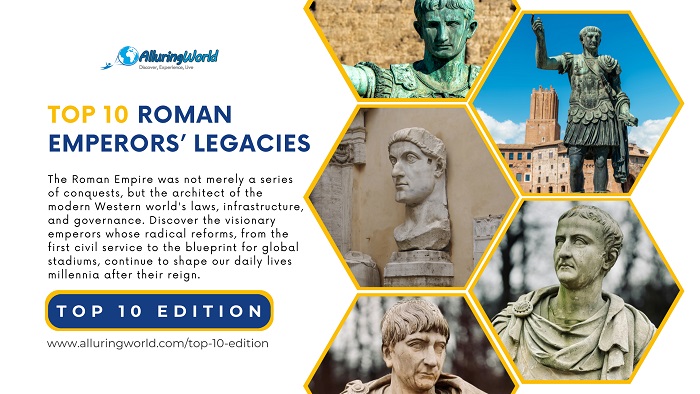
The Roman Empire is not just conquests and legions, as the majority of people think, but it is the crucible wherein much of the Western world’s foundational structures were forged. With the fall of the Western Roman Empire in 476 AD, its continuous work with the administration, architecture, legal systems, and even the practiced cultural norms resonates loudly in our lives today. Nowadays, we walk on roads that they started building, following the routes they had in mind, following the languages that are derived from their tongue, and even utilizing legal concepts they codified.
However, Rome was not a monolith; its trajectory was shaped by the individuals holding supreme power. Since some emperors are remembered as tyrants whose impact was ephemeral, there are others who were true visionaries and implemented changes that outlived them by millennia. Here you will be able to get a glimpse of those great leaders who made an impact on the world, and with their thinking and leadership, we are enjoying today the fruits of their labour.
1. Augustus (ruled 27 BC – 14 AD)
Being the first official emperor, Caesar Augustus inherited a republic that was being fractured under civil war, and he transformed it into a stable, autocratic empire. He is the architect of the Pax Romana (Roman Peace), a roughly two-century period of relative stability that allowed trade and culture to flourish.
Why he matters today: Augustus realized that a great empire needs something more than just great soldiers who will conquer new lands. He knew that a land to thrive needs professional administration. He established the world’s first true civil service, creating career paths for administrators rather than relying solely on nobility. Furthermore, he also instituted the vigiles urbani, who were the direct historical precursors to modern municipal police and fire departments. As you depend today on public safety or interact with a government agency, you are experiencing an evolution of Augustan reforms.
2. Claudius (ruled 41 – 54 AD)
Often underestimated by his contemporaries due to physical weaknesses, Claudius was an astute intellectual and a highly competent administrator. One of the most important works he’d done was the centralized governance, as he took power away from the Senate and placed it into the hands of capable, professional bureaucrats. The most crucial detail is that he put the governance into the hands of the bureaucrats, with the majority of whom were former slaves, and lived at that time as freedmen.
Why he matters today: Claudius significantly expanded the empire’s infrastructure, most notably through massive aqueduct projects, as Claudius received advisory notes from the Senate, which he formed with professional bureaucrats. Even though there is no clear evidence of who invented the aqueduct, emperors like Claudius scaled the technology to support massive urban populations. The concept that a government is responsible for providing clean, running water to its citizens on a massive scale is a distinctly Roman expectation that remains a cornerstone of modern urban planning and public health.
3. Vespasian (ruled 69 – 79 AD)
During the messy “Year of the Four Emperors,” which was a chaotic period of civil war in the Roman Empire following Emperor Nero’s suicide, during which four emperors: Galba, Otho, Vitellius, and Vespasian, ruled in quick succession, Vespasian emerged as the victorious end. He was a pragmatic general who restored fiscal discipline to a bankrupt state. Since he understood clearly the necessity of public buy-in for a new dynasty, he made essential reforms that stabilized the empire.
Why he matters today: Vespasian’s most visible legacy is the Flavian Amphitheatre, better known as the Colosseum. Even though he did not finish it, and Emperor Titus completed the work, this structure wasn’t just art. It was advanced engineering used for mass entertainment, since this was a structure that had an impeccable and newly introduced design with tiered seating, multiple entrances for crowd control, numbered gates, and retractable roofing mechanisms. Until today, the Colosseum remains the architectural blueprint for virtually every modern sports stadium and entertainment arena globally.
4. Trajan (ruled 98 – 117 AD)
The Emperor Trajan ruled over the Roman Empire when it was at its greatest territorial extent, so he is notably remembered as the “optimus princeps,” or as the English translation would be the “best emperor.” He was a tireless administrator and a prolific builder whose public works improved lives for all citizens across the Mediterranean.
Why he matters today: Despite his great military conquests, Trajan is remembered as the emperor who implemented a groundbreaking social welfare program known as the alimenta. By using public funds, this system subsidized the care and education of poor children only on the Italian peninsula, which was the heartland of the Roman Empire. This is considered to be one of history’s earliest recorded instances of state-sponsored social welfare, consequently setting a precedent for the modern idea that a government has a moral obligation to provide a safety net for its most vulnerable citizens.
5. Hadrian (ruled 117 – 138 AD)
When Emperor Hadrian took control over the empire, he shifted the empire’s focus from expansion to consolidation. He famously toured his vast domains to secure borders and improve provincial administration, something that was not seen by other emperors. He was an ardent philhellene and an amateur architect of significant skill.
Why he matters today: The best examples of his rule are the famous Hadrian’s Wall in Britain, which serves as the premier example of his policy of clearly delineated, fortified frontiers. This is a concept that is still relevant in modern geopolitics, and even some countries continue to practice it to this day. Architecturally, another of his feats was the reconstruction of the Pantheon in Rome, as this left us with the world’s largest unreinforced concrete dome. This building continues to inspire architects today, teaching lessons about spatial design and the endurance of Roman concrete technology, which modern engineers are still trying to replicate fully.
ADVERTISEMENT
6. Marcus Aurelius (ruled 161 – 180 AD)
The last of the so-called “Five Good Emperors,” Marcus Aurelius spent much of his reign defending the empire on its northern frontiers. Yet, he is best known not as a warrior, but as a philosopher.
Why he matters today: His personal writings, known today as Meditations, were never intended for publication but have become one of the seminal texts of Stoic philosophy. Since we live in a high-stress world, Marcus Aurelius’s insights on duty, resilience, controlling one’s reactions, and finding inner calm provide a psychological toolkit utilized by cognitive behavioral therapists and leadership coaches worldwide.
7. Diocletian (ruled 284 – 305 AD)
Diocletian ended the disastrous “Crisis of the Third Century” through sheer political will. Because he realized that the empire had become too vast for one man to rule, he instituted the Tetrarchy. What this meant was to divide the empire into East and West with senior and junior emperors, for better ruling.
Why he matters today: While his specific governing system eventually collapsed, Diocletian’s administrative reorganization permanently changed how large territories were managed. He increased the size of the bureaucracy and reformed taxation structures to fund the military and government directly. His recognition that vast geographical areas require subdivided, regional governance structures is a principle applied in large federal nations today.
8. Constantine the Great (ruled 306 – 337 AD)
Constantine is perhaps the most consequential emperor regarding the cultural trajectory of the West. He was the first Roman Emperor to adopt Christianity as his religion, consequently issuing the Edict of Milan, which legalized a previously persecuted minority religion and set the path for Christianity to become the dominant faith of Europe.
Why he matters today: Beyond the massive religious shift that completely changed the European continent, another feat was the relocation of the imperial capital. He was the Emperor who, in a bold move, moved the capital from Rome to Byzantium and renamed it Constantinople, nowadays known as Istanbul. This shifted the center of geopolitical gravity eastward, and it allowed for the preservation of Roman law and culture in the East for a thousand years after Rome fell in the West. This new capital acted as a bridge between antiquity and the modern era, ensuring the survival of classical texts that fueled the Renaissance.
9. Theodosius I (ruled 379 – 395 AD)
While Constantine legalized Christianity, Theodosius made it the official, sole state religion of the Roman Empire. He was also known as the last emperor who ruled the Eastern and Western halves of the empire united.
Why he matters today: The decisions of Theodosius cemented the relationship between church and state that defined European history for fifteen hundred years. The organizational structure of the Catholic Church, with its dioceses and hierarchy, is something linked with the imperial administrative districts that were established by later Roman emperors. This integration of religious institutions into the state governance is something that is seen as controversial and, even today, sparks debates.
10. Justinian I (ruled 527 – 565 AD)
Though ruling from Constantinople long after the Western Empire fell, Justinian viewed himself purely as a Roman Emperor intent on restoring the empire’s former glory. While his reconquests were temporary, his intellectual contribution was eternal.
Why he matters today: Justinian ordered the colossal undertaking of compiling centuries of accumulated Roman legal rulings into a coherent whole: the Corpus Juris Civilis (Body of Civil Law). This monumental work did not just preserve Roman law, but it became the foundation for the “Civil Law” systems used today in most of continental Europe, Latin America, and many parts of Asia and Africa. Whenever a modern court interprets a contract or defines property rights based on written codes rather than judicial precedent, it is utilizing a system that was refined by Justinian’s jurists.
In conclusion, the Roman Empire did not vanish as some might think. This is an empire that was absorbed into the DNA of the civilizations that followed it. The ten emperors listed here were more than just distant autocrats in marble busts, as we see them today as systemic architects. Starting from the stadiums we cheer in and the roads we drive on, to the laws that protect us and the philosophies that guide us, the fingerprints of these rulers remain visible on the framework of our modern world. Recognizing their contributions allows us better to understand the deep historical roots of our contemporary society.