
Read time ca. 10 minutes
In 1453, the world witnessed one of the most transformative events in history, and this was marked by the fall of Constantinople to the Ottoman Turks. The mighty Byzantine Empire stood as a beacon of Christian civilization for over a thousand years, and it was the bridge that connected Europe and Asia, while it preserved the legacy of the once even mightier Rome, because this was the Eastern Roman Empire before being renamed to the Byzantine Empire. Constantinople, which was founded and named after the Emperor Constantine in 330 AD, was considered invincible because it was surrounded by powerful walls, which, together with the deep waters of the Bosporus, did not allow aggressors to come and conquer this seat of power. Yet, after centuries of decline, the empire’s last bastion succumbed to the might of Sultan Mehmed II and his formidable army. The capture of the city not only marked the end of the Eastern Roman Empire but also heralded the rise of the Ottoman Empire as a dominant power shaping the destiny of East and West alike.
The Last Days of the Byzantine Empire:
Unfortunately, due to the constant struggles, attacks, and continued decline, by the mid-15th century, the Byzantine Empire had been reduced to little more than the city of Constantinople itself and a few scattered territories. What was once a powerful and majestic empire, stretching from Spain to Syria, was divided into the Western and Eastern Roman Empire, so that it would struggle for survival. It has to be noted that the Byzantine Empire was a direct legacy of the Roman Empire, as it was the continuation of the Eastern Roman Empire that survived for almost a thousand years after the fall of the Western Roman Empire. Despite being called Byzantines, they still considered themselves to be Romans, and their empire preserved Roman laws, traditions, and culture, centered in Constantinople. Still, due to the many political divisions, economic hardship, and previous conquests, the Byzantine Empire had eroded its strength, so the Latin occupation of Constantinople during the Fourth Crusade in 1204 had weakened the empire beyond repair. When the Byzantines recaptured the city in 1261, its former glory was gone, and its treasury was empty.
When the Emperor Constantine XI Palaiologos ascended to the throne in 1449, he faced an almost impossible task that was in front of him. With very limited resources, a small army, and dwindling alliances, he stood against the rising Ottoman power that was under the leadership of Mehmed II. Due to the weakened Byzantine army, the emperor appealed to Western Europe for aid and to help them preserve the Christian Constantinople, but this largely went unanswered. Religious divisions between the Eastern Orthodox and Roman Catholic churches, which deepened by the Great Schism of 1054, made cooperation difficult. While a few Italian city-states sent mercenaries and supplies, the defense of Constantinople rested mainly on the courage of its inhabitants and their faith that the city blessed by God would endure.
The Rise of Mehmed II and the Ottoman Ambition:
Sultan Mehmed II, known later as “Mehmed the Conqueror,” came to power with a clear vision: to capture Constantinople and make it the capital of his empire. As the Ottomans expanded steadily throughout Anatolia and the Balkans, they saw the Byzantine capital as both a strategic and symbolic prize that would be a big crown for their empire. Even though Mehmed was only 21 years old when he launched his campaign, his ambition was immense. He recognized that controlling Constantinople would allow the Ottomans to dominate trade between Europe and Asia, solidify their power, and cement his legacy as one of history’s great rulers.
Determined and methodical, Mehmed invested in new military technologies and strategies. He commissioned the construction of massive cannons capable of breaching even the strongest walls. Among these was the giant bombard built by the Hungarian engineer Urban, which was an artillery piece so enormous that it required hundreds of men and oxen to transport. In addition, the Ottomans also built a massive fortress, better known as Rumeli Hisarı, and this was located on the European side of the Bosporus so that they would be able to control naval traffic and isolate Constantinople from aid. By early 1453, Mehmed’s preparations were complete, and his army, as it numbered around 80,000 to 100,000 men, marched with dedication and strong motivation toward the fabled city.
The Siege of Constantinople: A Battle of Faith and Strategy:
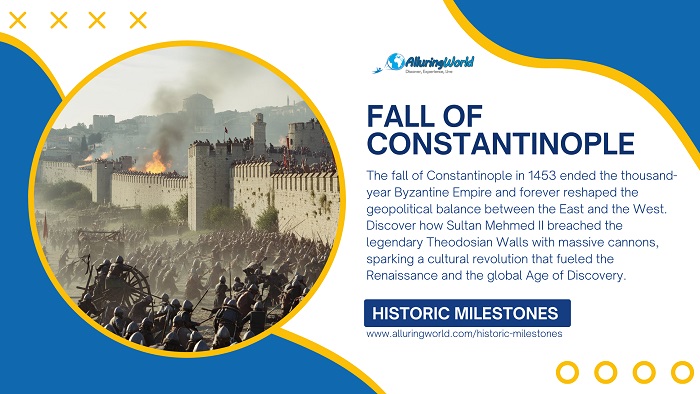
As the siege started on 6 April 1453, the Byzantine defenders were led by Emperor Constantine XI and the Genoese commander Giovanni Giustiniani; however, they numbered fewer than 8,000, including soldiers, volunteers, and civilians. Since they were facing overwhelming odds, they relied on the Theodosian Walls, as these were three layers of formidable stone defenses that had protected the city for nearly a millennium. In the past, these walls had withstood countless assaults from Persians, Arabs, and Crusaders, and they were considered a great advantage in defending the city, but the Ottomans brought a new kind of warfare.
As Mehmed’s cannons began a relentless bombardment, they managed to damage the ancient fortifications, and in the following weeks, the defenders worked tirelessly to repair breaches while they were still under constant fire. It was unfortunate at sea as well because the Byzantine fleet struggled to block the Ottoman navy, as they used small, maneuverable ships to attack from multiple fronts. One of the most dramatic moments came when Mehmed ordered ships to be hauled overland on greased planks to bypass the chain barrier blocking the Golden Horn, and this is considered a brilliant maneuver that stunned the defenders.
Despite exhaustion, the Byzantines refused to surrender, so their inhabitants flocked to the city’s churches where they prayed, and even the Emperor Constantine fought alongside his soldiers, embodying the spirit of resistance. But by late May, morale was breaking. Sadly, on the night of 28 May 1453, Constantinople’s defenders held a final service in the then church of Hagia Sophia, where citizens, clergy, and warriors gathered in unity, but at dawn on 29 May, Mehmed launched his final assault on Constantinople, which was the last blow that the city could not withstand. The Ottoman army surged through breaches in the walls, overwhelming the weary defenders, and even Emperor Constantine XI is said to have cast off his imperial insignia and charged into battle, perishing in defense of his city.
ADVERTISEMENT
The Fall of a Civilization and the Rise of a New Era:
When Ottoman troops poured into Constantinople, the then well-known thousand-year Byzantine Empire ceased to exist. The city was plundered according to the custom of war, but Mehmed II quickly restored order and imposed the new Ottoman rules and regulations. Entering the city on horseback, he rode to the Hagia Sophia, which was then a great symbol of Orthodox Christianity, and ordered it to be converted into a mosque. Interestingly enough, in this act, he also proclaimed his role as protector of all faiths within his empire, allowing Christian communities to continue to practice their religion and religious customs under Ottoman rule. Constantinople, renamed Istanbul in later centuries, became the new capital of the Ottoman Empire and the heart of a vast multicultural realm spanning three continents.
The fall of Constantinople sent shockwaves throughout Europe. To many in the Christian world, it was a devastating loss, as some would call it the “Queen of Cities,” and the gateway to the East was now in Muslim hands. Because not all people wanted to live in this new world, scholars and artists fled the city and carried with them ancient manuscripts and knowledge, and this is seen as something that would later fuel the Renaissance in Western Europe. Even though it would take decades for the Renaissance to emerge, in the meantime, the Ottomans gained a capital of immense strategic value that was seen as a cultural center that would flourish for centuries as a nexus of art, science, and trade.
Transformation and Legacy of the Conquest:
After the successful conquest of Constantinople, Mehmed II transformed the city into a vibrant imperial capital. He managed to rebuild its infrastructure, he further encouraged immigration, and he even repopulated the city with Muslims, Christians, and Jews alike. The Ottoman administration established schools, mosques, markets, and palaces, turning the war-torn city into a thriving hub of civilization. The Topkapi Palace, constructed soon after the conquest, became the seat of Ottoman power for centuries.
The fall of Constantinople also marked the end of the medieval era and the beginning of a new global age. As the eastern trade routes would be controlled by the Ottomans now, European powers began searching for alternative paths to Asia, and this would be considered an endeavor that would lead to the Age of Exploration. The event led to the very important voyages of Columbus, da Gama, and Magellan, as all of them managed to reshape global history and the world as it was known back then.
Culturally, the blending of Byzantine and Ottoman traditions gave Istanbul its unique identity, for which the city would be recognizable throughout the centuries. It was Hagia Sophia and its architectural legacy that would influence the construction of grand mosques such as the Blue Mosque and Süleymaniye Mosque, where domes, minarets, and intricate calligraphy embodied the empire’s artistic vision. The city became not only a political capital but also a symbol of coexistence and cultural synthesis.
The Symbolism of 1453 in Modern Perspective:
Even centuries later, the fall of Constantinople remains one of history’s most symbolic moments in history. On one hand, it was the fulfillment of a prophecy and the triumph of perseverance and faith for the Ottomans, while on the other hand, for Europe, it was both a warning and an inspiration that was used as a catalyst that forced nations to innovate and expand beyond familiar boundaries.
The historians today often view it as a pivotal turning point that links the ancient world to the modern one, rather than the end of a former empire. Despite the Byzantine Empire no longer exists, its legacy, as it is preserved through art, architecture, and scholarship, continues to influence both Eastern Orthodoxy and Western civilization even today. As the Ottoman Empire rose from the ashes, it would itself endure for more than 600 years, shaping the geopolitics of Europe, Asia, and the Middle East.
Conclusion:
In closing, the fall of Constantinople in 1453 was more than the capture of a city. This was the transformation of an era where the Byzantine Empire’s demise gave rise to a new power, one that would redefine the balance between East and West for centuries to come. From the courage of the Christian Emperor Constantine XI to the vision of the Muslim Ottoman leader Mehmed II, the event stands as a testament to human ambition, faith, and resilience. The story of that fateful siege continues to resonate because it marks not just an end, but a beginning—a bridge between two worlds and two ages, forever shaping the course of history.