
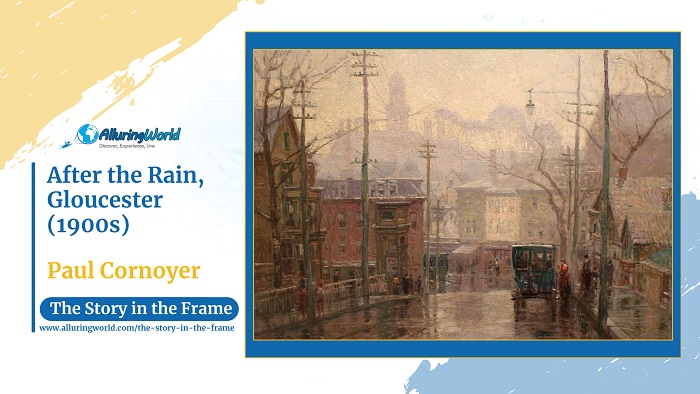
After the Rain, Gloucester is a luminous and atmospheric painting by the American Impressionist Paul Cornoyer, a master of urban and landscape scenes. Known for his ability to capture the interplay of light, atmosphere, and reflection, Cornoyer painted this view of Gloucester, Massachusetts, with a sensitivity that transforms a quiet city street into a poetic study of rain, mist, and motion. His treatment of wet pavements, soft haze, and delicate tonal shifts creates a mood that is both serene and contemplative, offering viewers a glimpse of everyday beauty in the wake of rain.
About the Painter:
Paul Cornoyer (1864–1923) was an American painter best known for his Impressionist depictions of cities and towns, often in misty or rainy conditions. Born in St. Louis, Missouri, he studied at the Académie Julian in Paris, where he was influenced by French Impressionism and Tonalism. Upon returning to the United States, he became associated with the American Impressionist movement, particularly in New York and Massachusetts. Cornoyer had a remarkable ability to merge realism with atmospheric subtlety, turning urban and suburban scenes into lyrical works that balanced detail with mood.
Inspiration and Reasons Behind the Painting:
Cornoyer was especially drawn to scenes where weather and light altered the ordinary, lending them a dreamlike quality. After the Rain, Gloucester reflects his fascination with the transformative effect of rain on the urban landscape—streets gleaming with reflections, softened silhouettes of buildings, and a lingering mist that quiets the city’s usual bustle. Gloucester, with its unique mix of maritime life and old New England architecture, offered Cornoyer an inspiring setting where he could explore atmosphere, reflection, and tonal harmony. This painting reflects both his Impressionist sensibility and his poetic view of modern life.
What is Depicted in the Painting:
The painting shows a Gloucester street after rainfall, the cobblestones and pavement glistening with water that mirrors the muted light of the sky. Horse-drawn carriages and a few pedestrians animate the scene, but the overall impression is one of tranquility and stillness. Telephone poles, wires, and the silhouettes of distant buildings emerge faintly through a veil of mist, their forms softened by the damp air. The composition draws the viewer’s gaze down the street, where atmosphere and architecture merge in a delicate haze, creating a sense of depth and quiet movement.
Colors and Techniques:
Cornoyer’s palette in After the Rain, Gloucester is restrained, dominated by grays, browns, and muted greens, with subtle touches of red and yellow that add warmth. His brushwork is loose yet controlled, allowing reflections on wet surfaces to shimmer without losing clarity. The tonal harmony of the piece, characteristic of his style, blends Impressionist light with Tonalist subtlety, producing a painting that feels both realistic and dreamlike. The soft gradation of mist and light demonstrates Cornoyer’s skill in conveying atmosphere, giving the viewer a palpable sense of damp air and lingering rain.
Conclusion:
After the Rain, Gloucester stands as a fine example of Paul Cornoyer’s ability to elevate ordinary urban and small-town scenes into poetic visual experiences. By focusing on atmosphere, reflection, and mood, Cornoyer captures not just the look but the feeling of a rainy day in Gloucester. His sensitive treatment of light and texture ensures that the work remains timeless, continuing to resonate with viewers who find beauty in the fleeting and the everyday.