
Read time ca. 7 minutes
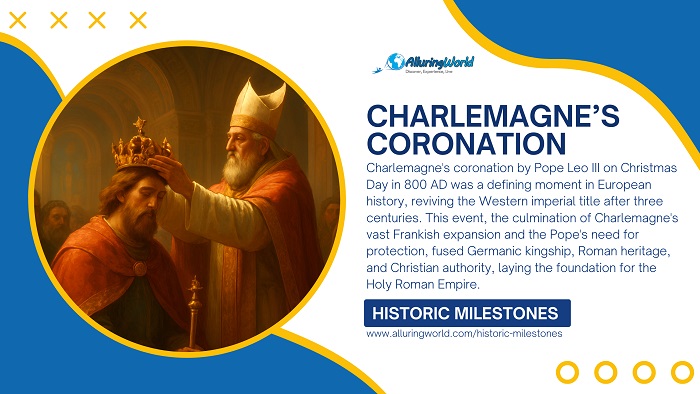
Charlemagne’s coronation by Pope Leo III, which occurred on 25 December 800, stands as one of the most defining moments in European history. This moment marked the revival of the Western imperial title after more than three centuries, reshaped the political landscape of medieval Europe, and laid the foundation for what would later be called the Holy Roman Empire. This event was not sudden; it is considered to be the culmination of shifting alliances, religious tensions, and the growing authority of the Carolingian dynasty.
The Road to Power: Charlemagne’s Expanding Influence
The story began decades before the coronation, rooted in Charlemagne’s expansion of Frankish authority across Western and Central Europe. Since Charlemagne was the King of the Franks and later ruler of the Lombards, he built a realm that stretched from the Atlantic to modern-day Austria. His military campaigns strengthened the Franks’ dominance, subdued rival powers, and brought political stability to regions that were long marked by fragmentation following the fall of the Western Roman Empire.
The expansion that happened during Charlemagne’s rule was seen as a success, which also transformed him and was seen by the people as a protector of Western Christendom. He defended the Papal States, supported missionary efforts, and helped establish uniform religious practices across his territories. His growing partnership with the Church elevated him beyond the status of a regional king: he became the most powerful Christian monarch in the West, a figure whose authority rivaled the emperors of Byzantium.
The Crisis in Rome: Pope Leo III Seeks Protection
The events leading directly to the coronation began with a political crisis in Rome. The then-ruling Pope Leo III faced strong opposition from Roman nobles who questioned his legitimacy and accused him of misconduct. With the evolving situation, it was in 799 when he narrowly escaped an attempt on his life and fled north to seek Charlemagne’s protection.
Charlemagne welcomed Pope Leo III with open arms, and to ensure he would remain in his papal position, Charlemagne escorted him back to Rome. This was mainly to demonstrate the military strength he had at that time, in addition to his role as a stabilizing force for the papacy. There was an investigation that followed the accusations, but no conclusive evidence surfaced against the pope. With Charlemagne’s support, Leo retained his authority, largely due to the enormous support he received from the King of the Franks and the Lombards.
This moment cemented the pope’s reliance on Charlemagne. As the stability of Rome increasingly depended on the Frankish king, the idea of elevating him to imperial status grew more appealing to Leo III.
A Political Vision Takes Shape:
There were spiritual and political motivations that influenced the concept of restoring the Western imperial title. For the Church, elevating Charlemagne to emperor reinforced its independence from Byzantine influence. At the same time, the Byzantine throne was occupied by Empress Irene, whose legitimacy was contested by Western leaders who believed a woman could not rightfully rule an empire.
In this context, Leo III saw a great opportunity that should not be missed: he could acknowledge the political reality that Charlemagne commanded the greatest Christian kingdom in the West and reward him with an imperial crown. The coronation would also publicize the message that the papacy possessed the divine authority to grant imperial legitimacy.
On the other hand, for Charlemagne, this new imperial title offered a new layer of prestige. Even though he did not intend to initiate the idea, despite some sources stating that the coronation could have been anticipated, there is no doubt that the title strengthened his position as the great central ruler of Latin Christendom.
ADVERTISEMENT
The Christmas Coronation: A Defining Moment
The moment when Charlemagne was crowned happened on Christmas Day in the year 800. He attended mass at St. Peter’s Basilica in Rome, and it was during this sacred ceremony that Pope Leo III placed a crown upon Charlemagne’s head, thus proclaiming him “Emperor of the Romans.” This was such a significant event for many of the people who attended this process, so the congregation erupted in acclamations, acknowledging him as the rightful successor to the long-lost Western Roman emperors.
This coronation symbolized the fusion of Germanic kingship, Roman political heritage, and Christian religious authority, and it revived the idea of a single and unified Christian empire in the West, which would mark a new chapter in European governance and identity.
After the Coronation: An Empire Reborn
Following his new title, his relationship with the surrounding powers started to be transformed. At the beginning, the Byzantine Empire refused to recognize his imperial status, hence why diplomatic negotiations were ongoing so that in the end they would mutually acknowledge Charlemagne as the Crowned Emperor. As the West during that time was still influenced by Roman traditions and Christian ideology, Charlemagne’s coronation managed to bring something different to the table and started changing the medieval political system.
There were numerous administrative reforms followed, and as these strengthened the governance across his realm, the new Holy Roman Emperor continued with his vision and promoted standardized laws, supported education, and encouraged the preservation of classical learning, which in turn helped to ignite the Carolingian Renaissance. The coronation became the symbolic starting point for the empire that would evolve, centuries later, into the Holy Roman Empire.
A Legacy That Reshaped Europe:
Charlemagne’s coronation did more than elevate him as a king. This significant event managed to redefine the relationship between the Church and secular rulers, introduced the concept of a Christian empire in the medieval West, and was the beginning of something that would influence European politics for nearly a millennium. The idea that the pope could bestow imperial authority had long-term consequences for Church–State relations, setting the stage for future conflicts and collaborations.
The coronation also contributed to a renewed sense of identity rooted in Roman tradition, Christian unity, and Germanic political structures. Unfortunately, Charlemagne’s empire would not survive intact after his death, but the ideals and institutions he fostered throughout his life and rule endured. They shaped governance, education, and diplomacy throughout the Middle Ages, and they were well passed into the early modern period.
Conclusion:
To sum it all up, the crowning of Charlemagne as emperor in 800 was a defining milestone in Western history. Because it emerged from political necessity, religious alliance, and the immense power that followed, it managed to make Charlemagne a ruler across Europe as an accepted ruler, and this event proved to be how the Western world of that time would shape and evolve into something that we have today. Reviving imperial authority in the West, as this altered the balance of power between Church and monarchy, it also sparked a cultural and administrative developments that continue to influence Western society. By merging Roman heritage with medieval innovation, this historical milestone marked an era in European history that would be further felt on different continents for centuries to come.