
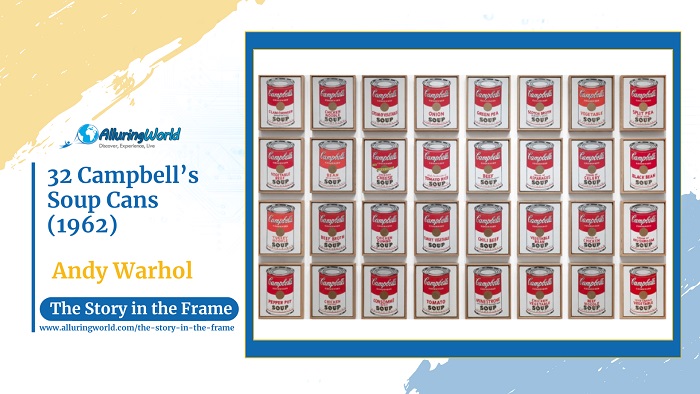
Created in 1962, 32 Campbell’s Soup Cans by American artist Andy Warhol is a defining work of the Pop Art movement, transforming everyday commercial imagery into fine art. The series exemplifies Warhol’s exploration of consumer culture, mass production, and the intersection of art and popular media, turning a mundane grocery store item into a cultural icon.
About the Painter:
Andy Warhol (1928–1987) was an American artist and a leading figure in Pop Art, renowned for his work with commercial imagery, celebrity culture, and mass media. Trained in commercial illustration in Pittsburgh, Warhol developed a style that combined meticulous design with conceptual innovation, often employing repetition and mechanical techniques such as silkscreen printing. His work challenged traditional notions of originality, art, and culture, making him one of the most influential and controversial artists of the 20th century.
Inspiration and Reasons Behind the Painting:
Warhol painted 32 Campbell’s Soup Cans during a period of fascination with consumerism and everyday objects in American life. The work reflects his interest in the proliferation of mass-produced goods, advertising, and the visual language of commercial packaging. By presenting the soup cans as art, Warhol blurs the line between high art and popular culture, inviting viewers to reconsider the value and meaning of everyday objects in modern society.
What is Depicted in the Painting:
The composition consists of 32 individual canvases, each depicting a single Campbell’s Soup can, representing different flavors available at the time. Each can is rendered with precise detail, replicating the label design, typography, and branding. Displayed in a grid-like arrangement, the repetition emphasizes uniformity, mass production, and the omnipresence of consumer goods. The work transforms a simple household product into an emblem of contemporary life, reflecting both familiarity and cultural commentary.
Colors and Techniques:
Warhol employs a clean, flat color palette dominated by reds, whites, and yellows, mirroring the commercial packaging of the soup cans. His brushwork is precise, methodical, and detached, creating uniformity across the series. The repetitive, serial presentation enhances the sense of mass production, while the bright, contrasting colors draw attention to the commercial design and cultural significance of the objects. The technique highlights the aesthetic qualities of everyday consumer products while maintaining conceptual depth.
Conclusion:
32 Campbell’s Soup Cans exemplifies Andy Warhol’s innovative approach to Pop Art, turning ordinary commercial imagery into a profound commentary on consumer culture, mass production, and modern society. Through repetition, precise representation, and bold color, Warhol elevates a mundane object to cultural icon status, creating a work that remains both visually striking and conceptually influential in the history of contemporary art.